Developing an algae-based building material

Flora Materials is a biomaterials company that develops sustainable, bio-based building materials.
Client
Flora Materials
Industry
Biotechnology
What client brought
Design
Service provided
Prototyping
Background
The construction industry produces over a third of the world's greenhouse gas emissions. The production of polyvinyl chloride (PVC) flooring — such as Luxury Vinyl Tile (LVT) and Stone Plastic Composites (SPC) — alone contributes more than 10 million tons of CO₂ annually. An alternative with organic and biodegradable origins could significantly reduce these emissions, and algae might be the answer. Algae naturally turns CO₂ into biomass and produces oxygen, making it a potentially carbon neutral alternative.
Founded in 2020 to research and develop biomaterials, Flora Materials partnered with the University of Utah to develop an algae-oil-based polyurethane for construction. Their bio-based plastic film won them a Small Business Innovation Research (SBIR) Phase I grant to explore how algae-based plastic could be used for commercial and residential construction. With a background in architecture and design, Flora sought out expertise in engineering project management and product development.
Work
Flora came to Second Order Effects (SOE) for initial analysis, testing, and prototyping. SOE established desired product characteristics, found optimal material compositions to balance sustainability and performance, and produced bio-based flooring prototypes using an algae-oil-derived polyurethane as engineering validation.
In the architecture phase, SOE investigated industry-standard flooring properties, testing methods, and sustainability certifications to determine what baseline requirements Flora’s product should meet.
Of the relevant mechanical properties evaluated, SOE determined the initial targets that would be most useful to measure overall product performance were elasticity, strength and stiffness. USDA Biopreferred Certification would also place Flora’s product on a Mandatory Federal Purchasing list, allowing US government agencies to be the end customer. This certification requires flooring products to have 91% bio-based mass, so SOE established this as an additional target.
Simultaneously, SOE reverse engineered samples of LVT and SPC to determine the primary flooring layers, material composition, and assembly processes. The teardown established five common layers: Topcoat, Wear, Design, Core, and Backing. SOE used their thickness, mass, and density to establish upper and lower benchmarks for each layer.
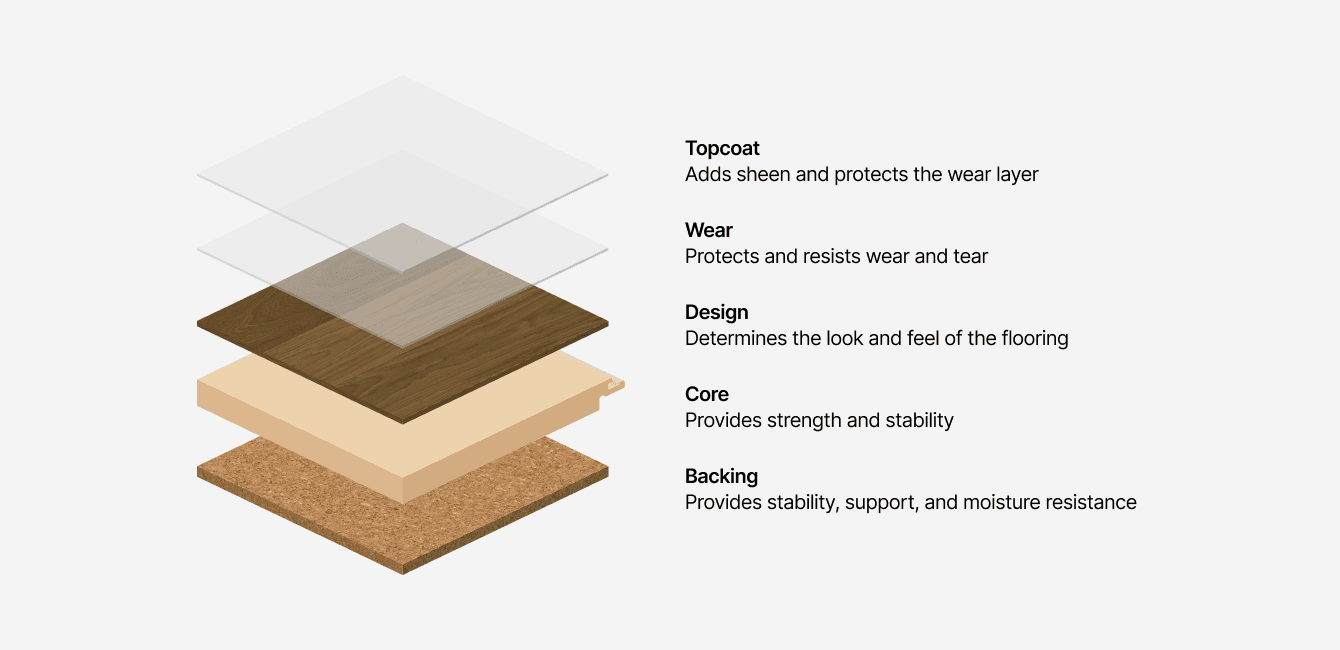
Based on these benchmarks, SOE identified Flora’s original bio-based plastic film most closely matched the Design layer. However, Flora’s product needed to reduce even more of the floor’s PVC composition to impact the product’s sustainability. The Core layer contributed 65%-94% of the floor’s mass. Finding a bio-based alternative for this layer would replace the most fossil fuel derived materials. To keep the final product algae-based, SOE found two alternative off the shelf, algae-oil-based liquid polyurethane casting kits.
These kits were chosen since they had had 56% bio-based content and the desired manufacturing method was casting. SOE tested the materials at various ratios, investigating curing times, composite ratios, and resulting material properties to refine the mixing and casting process. To increase the desired characteristics of strength, elasticity, and stiffness while reaching 91% bio-based content, SOE explored composite filler materials that could be added to the polyurethane casting compounds. Potential bio-based fillers included bamboo, recycled wood flour, and pine rosin.
SOE created 40 unique 5.5”x.5” test samples of different composite filler types and mixing ratios. One sample composition reached 87% bio-based content. SOE continued to work toward the goal of 91%, but the 29% increase showed high probability that with future iterations the tiles would meet full USDA Biopreferred Certification. SOE sent 23 of the best compositions to the Utah Materials Research laboratory. The lab tested for tensile strength, compressive strength, Young’s modulus, and Shore D hardness using ASTM testing standards.
The lab test results, bio-content percentages, and manufacturability of each sample informed the down selection of composite materials that could replace the Core layer.
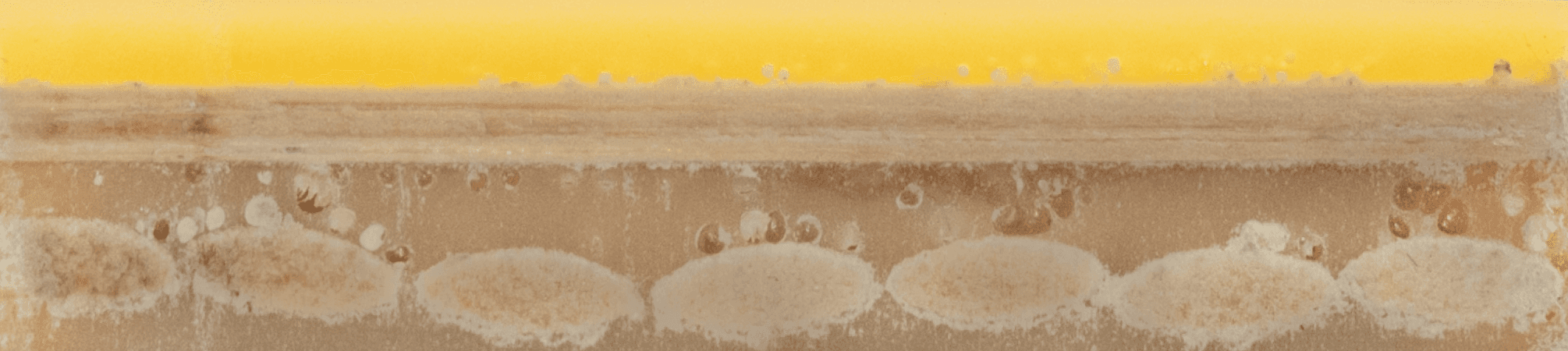
Cross-section of SOE’s 87% biomass sample composition
Results
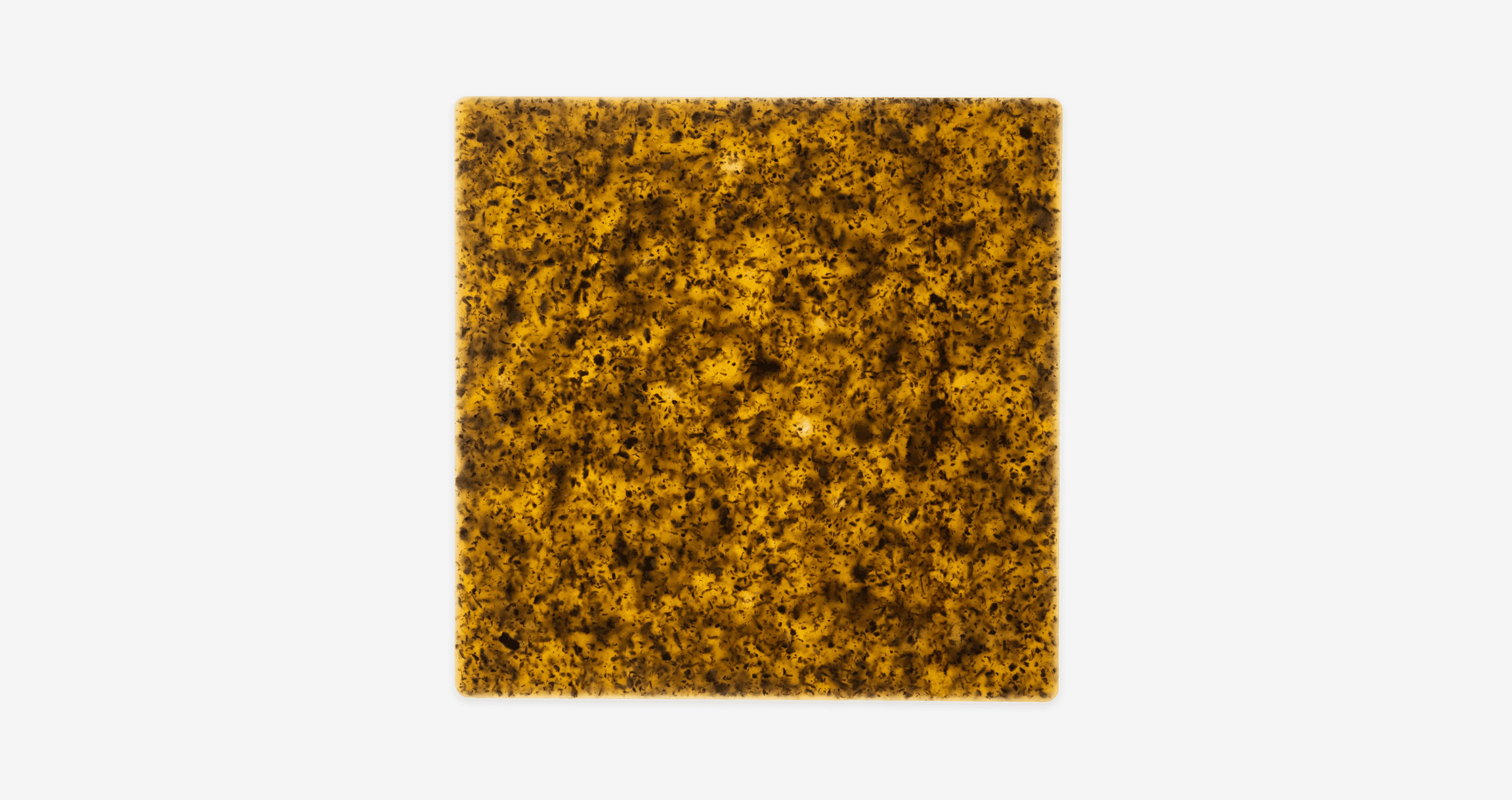
In a small batch production, SOE identified and partnered with a plastic prototype manufacturer to produce four units of 10”x10” bio-based polyurethane sample tiles. The prototypes validated the algae-based composite as a suitable PVC replacement.
Using low pressure injection casting to ensure compatibility with the reaction injection molding mass manufacturing process also validated production scalability to mass manufacturing.
Flora utilized SOE’s technical writing and documentation for their SBIR Phase II grant proposal. Flora won the grant for further product optimization and commercialization efforts. Now, SOE and Flora are continuing to work together through application methods that allow for mass production of the tiles.

Two of SOE’s 10”x10” bio-based polyurethane sample tiles
Post Project
Since completing the project with SOE, Flora has transitioned from research-to-production and successfully manufactured their first 800 square feet of bio-based flooring tile. As of Q4 2025, the company is preparing for its first product installation, a major milestone toward commercialization.